Articles & Deep Dives
As Technical Writers for System Weakness (a top cybersecurity and software architecture publication on Medium), the core maintainers of this project regularly publish deep-dive articles exploring the "why" behind our architectural decisions.
Welcome to our curated collection of technical articles offering advanced insights into Node.js, security, and scalable enterprise systems.
Architecture & Resilience
Weaponizing Logs: How Attackers Crash Apps via Synchronous Logging (And How ELK Fixes It) Trending on System Weakness
Published on: System Weakness (Medium)
Logging is essential for visibility, but when done synchronously under high load, it becomes a severe bottleneck. This article examines how attackers can intentionally trigger excessive log generation to exhaust the event loop and crash Node.js applications. Discover why we adopted the ELK stack with asynchronous, batched log shipping to guarantee system stability even during logging floods.
This article was featured on the Trending section of System Weakness: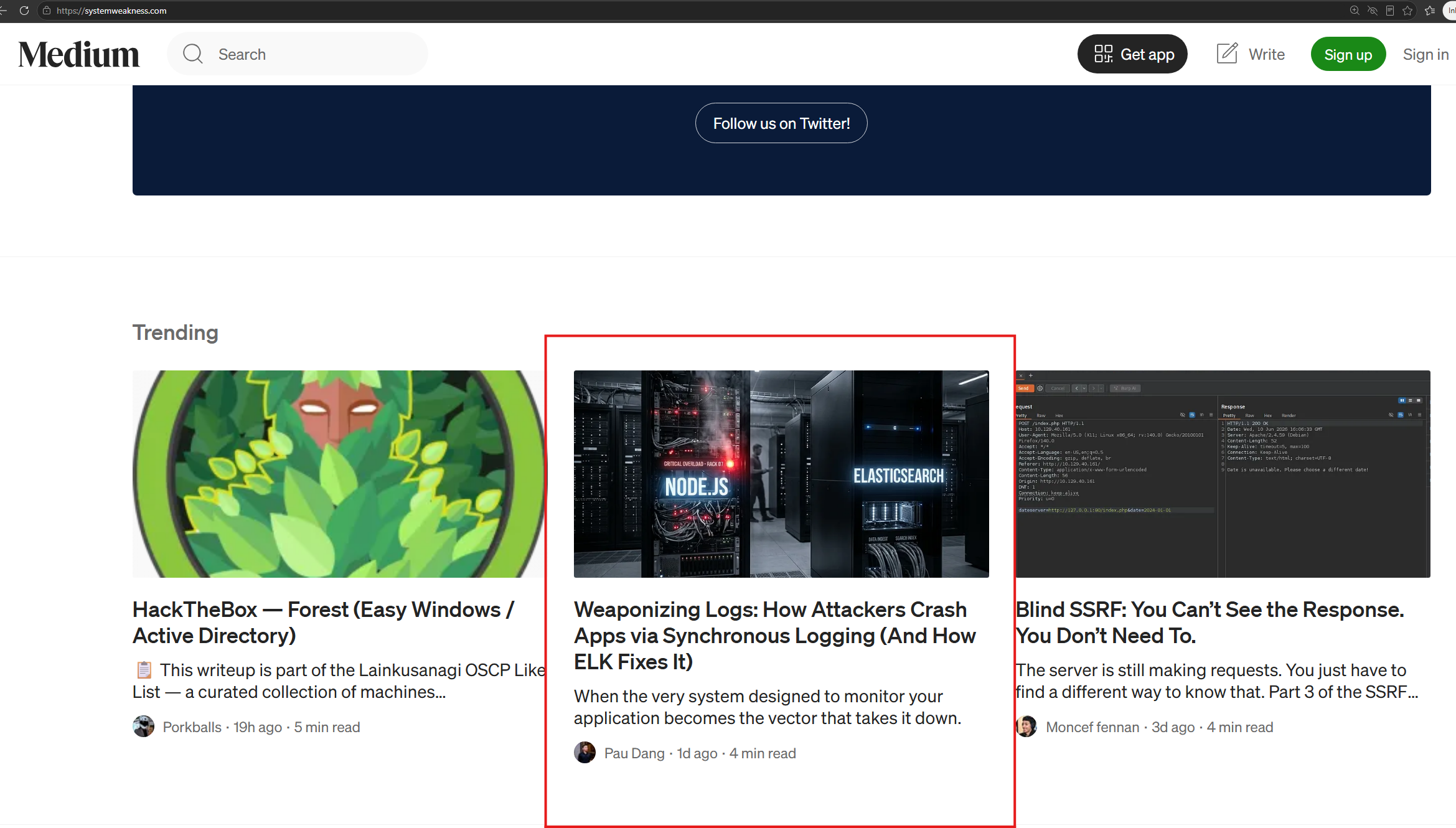
Why Your Node.js API Will Crash at 1,000 Req/s (And How to Fix It)
Published on: System Weakness (Medium)
A sudden spike in traffic can easily overwhelm your database connection pool, causing queries to time out and blocking web server threads. This article explores the anatomy of architectural weaknesses like TCP exhaustion and database bottlenecks under high load (1,000 Req/s). Discover how to prevent cascading failures by decoupling your ingestion layer from your persistence layer using asynchronous message brokers (Kafka, BullMQ) and Redis caching.
Weaponizing the Weakest Link: How Attackers Exploit Cascading Failures in Microservices
Published on: System Weakness (Medium)
Microservices are designed to be decoupled, but a failure in one service can easily cascade and bring down the entire system if not properly handled. This article explores how attackers can weaponize these weak links to trigger cascading failures and perform Denial of Service (DoS) attacks. We explain how to implement robust resilience patterns like Circuit Breakers, Retry mechanisms, and Timeouts to build fault-tolerant microservices that can withstand targeted disruptions.
Security & Authentication
Why Your Default VPC is a Hacker’s Playground: Designing a Zero-Trust AWS Architecture
Published on: System Weakness (Medium)
Many teams rely on the default AWS VPC setup without realizing the inherent security flaws it introduces. This article explores the vulnerabilities of default VPC configurations and provides actionable strategies for designing a robust, Zero-Trust cloud architecture to secure your infrastructure against lateral movement and unauthorized access.
The Illusion of Stateless Security: Rethinking JWT Revocation at Scale
Published on: System Weakness (Medium)
JSON Web Tokens (JWT) are often praised for being stateless, but this statelessness becomes a nightmare when you need to instantly revoke a compromised token. This article debunks the "stateless" myth in enterprise applications and explains why we implemented a Redis-backed blacklist and Refresh Token Rotation strategy.
The Social Login Trap: Architecting Defenses Against Account Takeovers
Published on: System Weakness (Medium)
Following up on the OAuth integration debt, this piece explores the devastating consequences of Account Takeovers (ATO) through social login mechanisms. We break down real-world attack vectors and outline the architectural defenses built into this scaffolding tool to prevent them from happening to your microservices.
The OAuth Integration Debt: Why Your Social Login is a CSRF Risk
Published on: System Weakness (Medium)
Integrating Social Login (Google, GitHub) seems straightforward until you realize the hidden security risks. This article dives into the often-overlooked vulnerabilities in OAuth flows, specifically Cross-Site Request Forgery (CSRF), and explains why a naive implementation can compromise your users. Read this to understand why our boilerplate enforces strict state checks and architectural safeguards.
Got an article about Node.js architecture or security? Feel free to submit a PR to add it to this list!